Down a rabbit hole with 'Mme Cornelissen'
One of my long-standing series of posts on social media is “What’s flowering at the Fuchsietum?” It’s not just about the fuchsias. Anything and everything in flower, at any season, might make an appearance. I always like to tuck in a few tidbits about a plant that people might find interesting.
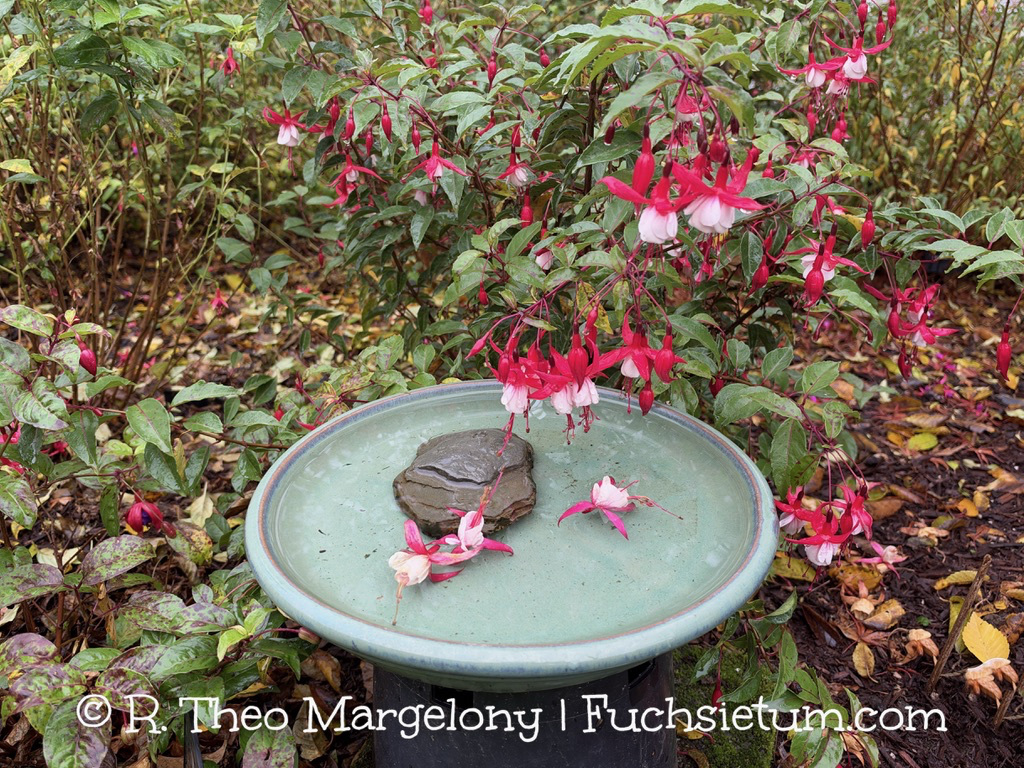
Earlier this week, I was looking at Fuchsia ‘Madame Cornelissen’. It’s the middle of November, and this classic beauty of the nineteenth century is still flowering grandly. It’s hardy, too, reaching about two and a half feet tall in a season for me.
But move over, Alice. Did I ever tumble down a rabbit hole with 'Madame Cornelisen'.
I started by looking for a who-done-it, a date, and a face to put to Madame Cornelissen herself. Almost immediately, some things didn’t make sense. The cultivar is usually attributed to “Cornelissen, 1860, Belgium.” Many references leave it at that. No first name. A bit frustrating when you’re exploring the stories behind plants, especially when Cornelissen and his plants were so widely recognized.
For well-known figures of horticulture past, such as Victor Lemoine, there’s usually much contemporary information to be found. It gets harder with breeders whose names survive only because they’ve been appended to a fuchsia or two.
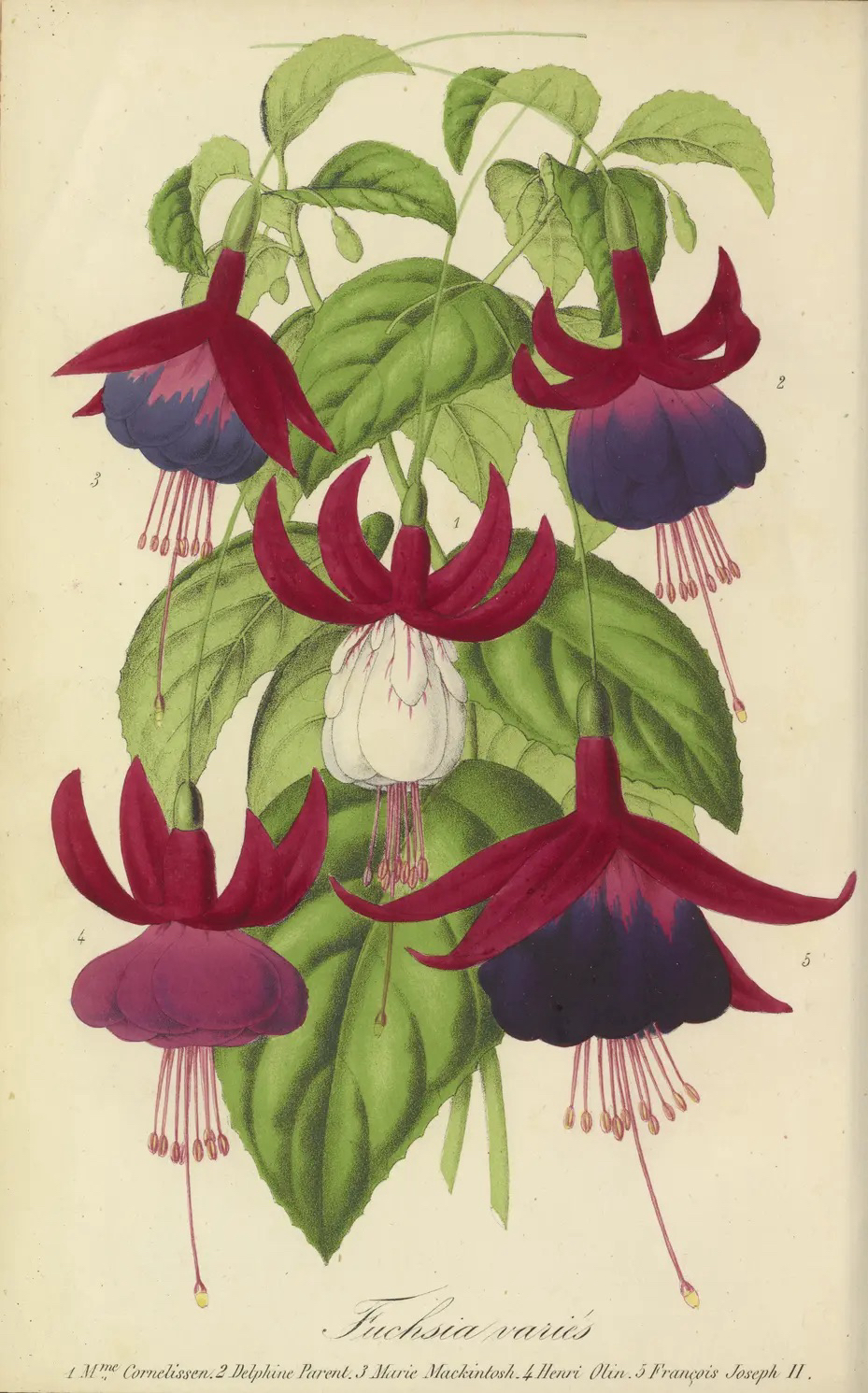
Cornelissen, though, was hardly a one-fuchsia wonder. Many of his plants appeared in sumptuous colored illustrations in places like the Revue Horticole. Even across the Atlantic, his large-flowered double blossoms were eliciting comments in the early 1860s. Their reputation probably traveled through magazines before the actual plants arrived.
You might think the basic facts about such a prolific and recognized hybridizer would be easy to find. After all, almost seventy fuchsias are attributed to him through various mentions and publications. There were probably more. Some may never have made it into print before disappearing from cultivation; others survive only in illustrations.
Not always so easy, though.
Today, he’s often identified as Louis Cornelissen—when he’s accorded an identity beyond the polite “M. Cornelissen” of his own time. It was that widely accepted first name that began to bother me as I looked more closely.
Yes, he was Belgian. Sometimes he’s placed in Brussels. More specifically, contemporary publications frequently locate M. Cornelissen in Saint-Josse-ten-Noode (Sint-Jost-ten-Node in Dutch), a small farming village then resting close on the outskirts of old Brussels.
His address was on the Rue Saint-Alphonse. Whether this was both his home and the nursery where he bred his many fuchsias, or perhaps only his home in later years, is less clear. Especially when you consider what fate was quickly bearing down on Saint-Josse.
The village had once held the estates of many nobles. Philip the Good, Duke of Brabant, even built a castle there, surrounded by vineyards. A cluster of grapes still appears on the town’s coat of arms.
A time-traveler from old Saint-Josse would hardly recognize the place today. Much of the village was annexed to Brussels already in 1855, and its urbanization followed very, very quickly. By the introduction of Fuchsia ‘Madame Cornelissen’ in 1860, development was already barreling down the Rue Saint-Alphonse.
Perhaps Cornelissen’s growing grounds had already moved a little further out by then, beyond the immediate reach of the land-hungry city. For a brief respite, anyway. In fact, by 1863 he's relocated his address to No. 8, rue du Sud, a street that no longer seems to exist. Development eventually engulfed all of Saint-Josse and its neighbors. The birthplace of his fuchsias lies buried under the modern cityscape somewhere.
His connection to Saint-Josse is frequent and firm in the records. His first name is another matter. I wasn’t finding a Louis Cornelissen connected with the place.
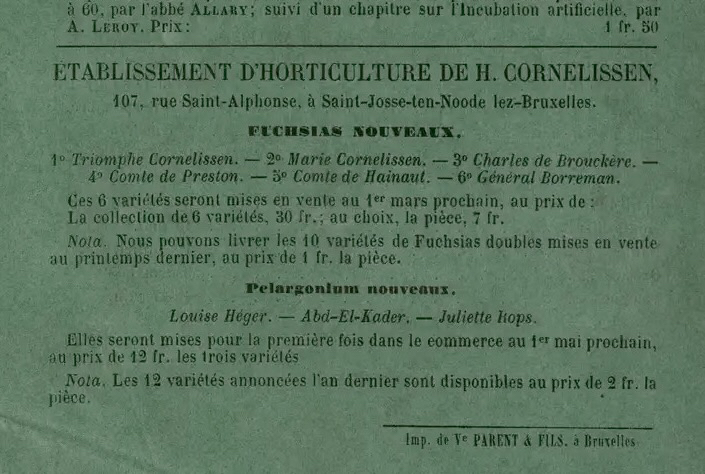
Then a significant clue turned up. An advertisement for fuchsias and pelargoniums that Cornelissen himself placed in the Journal d’Horticulture Pratique de Belgique in March 1861— The Établissement d’Horticulture de H. Cornelissen!
There it is. H. Cornelissen! Not L. Not Louis. Other references to “H. Cornelissen” eventually followed.
With that simple letter H, the pieces began falling into place, revealing the people behind M. and ‘Madame Cornelissen’.
From genealogical records, Henri Cornelissen was born in Saint-Josse-ten-Noode in 1814. Described as a jardinier, (gardener), and later a horticulteur (horticulturist), he was the son of Pierre Jean Cornelissen, also a gardener.
It’s tempting to imagine father, and then perhaps son, training and working on one of those noble estates before the Établissement came into being. That remains speculation, though. I haven’t found anything to establish whether Henri founded the firm or inherited it from his father.
More significantly for our story, Henri married Anne Marguerite Palmars in 1842.
Voilà! The woman behind Fuchsia ‘Madame Cornelissen’: his wife, Anne Marguerite.
Their children included Victor, born in 1844; Alphonse, in 1845; and Pierre Joseph, in 1849. There may have been others. Cornelissen named a number of his cultivars for family members, but those names still need to be matched to their namesakes.
That’s a rabbit hole for another time.
Unlike those of so many fuchsias of the past, the parents of ‘Madame Cornelissen’ are recorded: ‘Duchesse de Lancaster’ × ‘Roi des Blancs’, according to an 1860 account in the Horticole Practique de la Belgique.
‘Duchesse de Lancastre’ is almost certainly the French rendering of ‘Duchess of Lancaster’, raised by H. & R. Stirzaker in 1852. Henry and Richard ran a nursery in Skerton, Lancaster, and their hybrid was introduced by well-known nursery, E. G. Henderson & Son of St John’s Wood, London. It’s still grown today.
‘Roi des Blancs’ is attributed to M. Dubus in 1857, possibly the horticulturist H. Dubus of Rouen. That parent has since disappeared from cultivation.
One contemporary author praised Cornelissen as “sans contredit l’homme des fuchsias”—without question, the man of the fuchsias. He certainly helped put Brussels, if not all of Belgium, at the forefront of fuchsia breeding for a decade or two.
But the man of the fuchsias had other interests as well. He was responsible for a number of pelargoniums and even a Cereus cactus cultivar named ‘Madame Barbanson’.
One has to wonder how well Madame appreciated that singular honor.
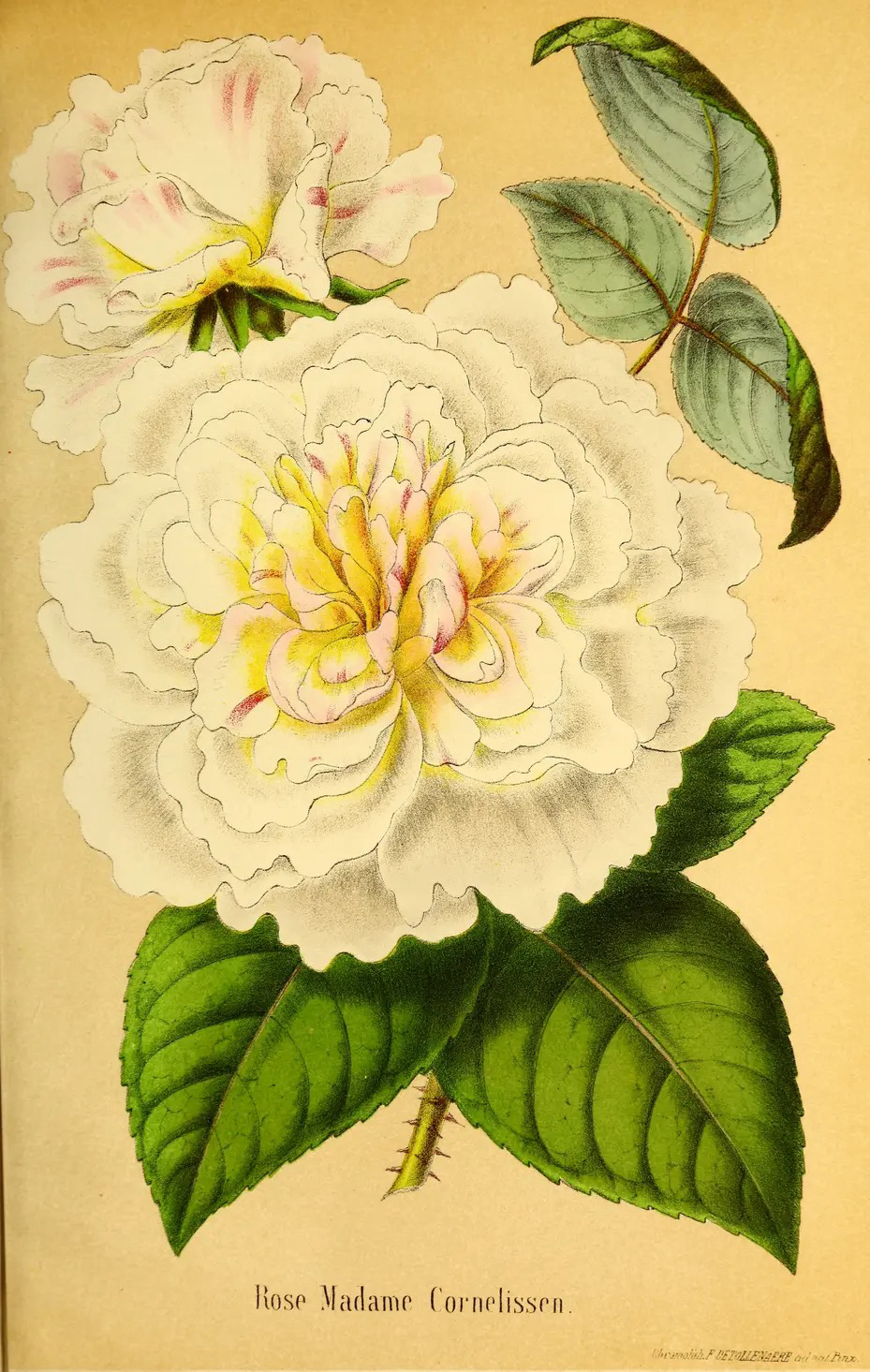
Anne Marguerite received a rose as well—Rosa ‘Madame Cornelissen’. Her husband discovered this fragrant Bourbon as a sport of ‘Souvenir de la Malmaison’ and dedicated it to his wife. An account in La Belgique Horticole in 1864 described his dedication of this queen of flowers to the sovereign of his heart.
Sadly, the sovereign of his heart died in 1869. Henri followed just three years later, in 1872.
But here she is, still flowering grandly in my November garden.
P.S. Cornelissen is sometimes misspelled “Cornellisen.” There’s also a modern tendency to give his Flemish patronymic a fancy French flourish: “Cornélissen.”